

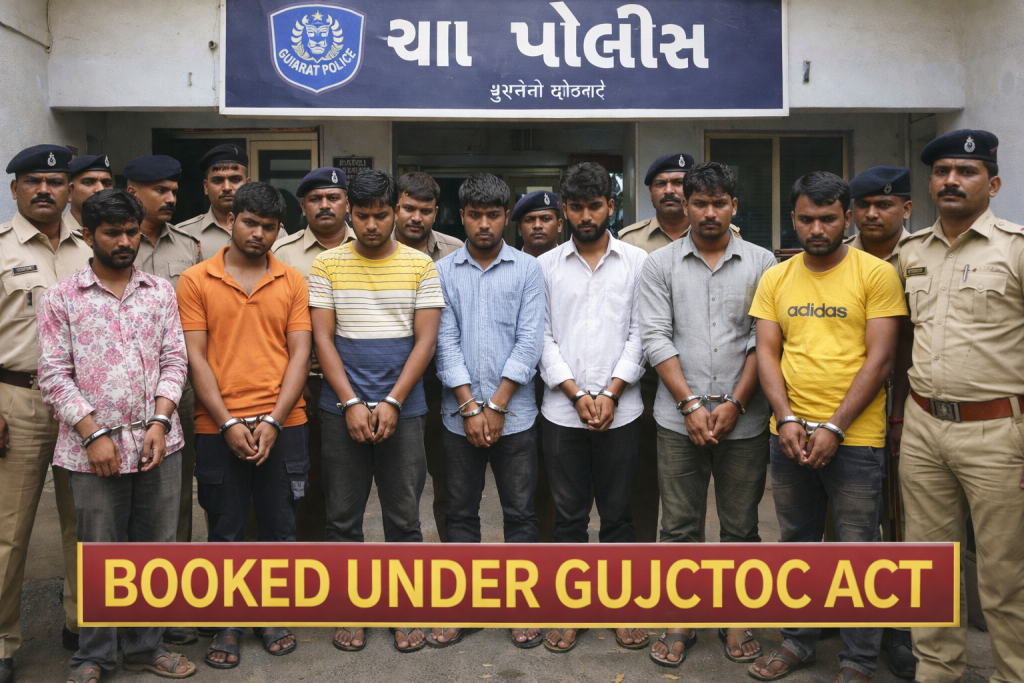
This powerful image documents a decisive moment in Gujarat’s ongoing fight against organised crime, showing ten alleged members of the notorious ‘Odiya Gang’ formally presented by police after being booked under the Gujarat Control of Terrorism and Organised Crime Act (GUJCTOC). The scene unfolds outside a police station, where the accused are lined up in full public view, reinforcing the transparency and seriousness of the legal process.
Each suspect stands with handcuffs secured, dressed in everyday civilian clothing, underscoring the sudden transition from ordinary life to criminal accountability. Their expressions range from tense to downcast, reflecting the weight of the allegations and the severe legal consequences associated with the anti-terror and organised-crime law. The restrained posture and silence of the accused convey the gravity of the moment.
Behind them, a row of Gujarat Police officers forms a protective and authoritative backdrop. The officers’ disciplined stance, official uniforms, and berets signal preparedness and vigilance, highlighting the coordinated effort required to dismantle an organised criminal network. The presence of senior personnel suggests the importance of the case and the scale of the investigation that led to these arrests.
The prominently displayed “BOOKED UNDER GUJCTOC ACT” banner anchors the visual narrative, making the legal action unmistakably clear. This caption not only informs the viewer but also serves as a strong public message that repeat offenders and organised gangs will be dealt with under the strictest provisions of the law. GUJCTOC, often invoked in cases involving long-term criminal conspiracies, indicates that investigators believe the gang operated in a systematic and organised manner across multiple incidents.
Contextually, the image represents the outcome of months or years of surveillance, intelligence inputs, and case consolidation, where police linked multiple offences to a single organised group. Such arrests typically follow extensive documentation of criminal history, witness statements, and inter-district coordination, especially when suspects have operated across state lines or jurisdictions.
Overall, the image stands as a visual testament to law enforcement’s resolve to curb organised crime in Gujarat. It communicates authority, accountability, and deterrence—assuring the public that criminal networks, regardless of their reach or longevity, are not beyond the reach of the law.